Creative Reuse Shopping

Everyone wants  to save money when crafting. Sewing and Quilting  can be expensive hobbies. Fabric bought new can be expensive. If you want to look for alternatives to buying new, and maybe save a little money, look into buying thrifted fabric or at creative reuse centers. 

Stephanie at Swooden Says has a great list of creative resuse stores across the US. You can find it  at https://swoodsonsays.com/a-creative-reuse-center-near-me-map-resource/ 

I'll talk about a few I'm familiar with below and some not on her list. 


Thistle has been  my local go-to shop for a long time. I have actually only been to the physical store a handful of times and primarily purchase from  their website and have my purchase shipped to me. What I love is that they often get vintage fabrics that are unique and  fun and sometimes I find the elusive out of print fabric that I have longed for. You just never know what you will find. Their prices are also really good and they have sales regularly. The one downside is that  you don't always know the fiber content of the material - but this is a common issue with all thrifted fabrics.


Untrash is very new. It was recently started by one of my neighbors. She sells a variety of craft items and always has a selection of fabric and notions in  her shop.


Feel Good Fibers is a fabric destashing platform. I love that shipping is free. You can find some bargains, but there are also a lot of postings for out of print fabrics that can be pricey. But it is always a fun  place to look for secondhand fabric. 


Super Textiles used to be located in Dallas, Texas on Perth Street on what was known as Fabric Alley (or the Fabric District). It was hit by a tornado in October 2019 and went to a virtual marketplace on Etsy in 2020. I loved Super Textiles for 2 things. One being that they sold a lot of dead stock fabric and you could find some fun stuff leftover from apparel makers for Anthropologie. Two - Buttons.  They have a HUGE assortment  of buttons (and a few other notions) at excellent prices. 


One of my local quilt shops, Not Your Mama's Quilt Shop, has a DeStash  Blast. This is a great opportunity to rent a spot to sell your stash you no longer want or to buy from other individuals who are looking to destash. I went last year and came home with an  armload of fabric for less than $20. Many of the Quilt Guilds had booths and had amazing deals. I found many sold fat quarter for a quarter and a yard of fabric could be bought for a buck or two. The next one is coming up and I will be going. 


My Local American Sewing Guild also has a regular fabric sale as well. It is also a great opportunity to get fabrics at an amazing price. I went last year and bought a  few bundles of quilting  cotton and some apparel fabrics.  They even had a huge amount of "scraps" that  were free! It was fun to dig around to see what I could find.  

I'd highly recommend checking with your local Guilds and Quilt Shops to see if they also offer these kinds of events. 

Then there are always thrift  stores. You would be amazed at what I find  at thrift stores. I get fabric there - sometimes full bolts. My mom found me a bolt of batting a few months ago that was unopened. It was 90" wide 20 yard bolt of Quilters Dream. I often peruse the clothing at thrift stores for fun  prints  that are cotton to cut apart for the fabric. I also check out the bedding section. Sometimes I find new sheets that I can use for quilt backs. I've also found vintage quilt tops that I plan to quilt and make a quilt coat with. If I do see a lot of fabric  in a thrift store, I will go look in their bins and pre-bagged stuff to look for things like quilting rulers and templates and have come across  some fun finds. 

I know I am likely forgetting some great online shops that specialize in  deadstock that are also great to shop at. I think  buying deadstock is a fantastic way to reduce the amount of textiles that end up in the landfill. I know there are many shops online that specialize in deadstock fabrics, but I am drawing a blank on them as I write this  blog. I honestly heave not done nearly as much fabric shopping  online as I have done in the past. I am  trying to be  more conscious of what I am buying and trying to avoid overbuying.  I hope you find these shopping suggestions helpful. If you have other places to recommend, I would love to hear them! Thanks!

Follow me on Instagram and Facebook!

Disclosure: This post may contain affiliate links. These links provide me with a small compensation if you make a purchase using my link. There is not cost to you when you do this. My thoughts and opinions given in this blog post are mine.

Quilted Postcard Tutorial

My Guest Blogger today is Erin. You can find her on Instagram @seamrippersociety

What if I told you that I could not only use up the smallest of your scraps but I could also help
you get them out of your house? If you’ve been quilting for any amount of time you inevitably
have handfuls of scraps all around your sewing room, some so small that it’s infeasible to make
anything of substance with them. Let me introduce you to the Send a Scrap Postcard Exchange.

My friend Alexis of @lexszymakowsi and I have organized a quilted postcard exchange in an
effort to clean out our closets of some of out smallest scraps and help quilters connect with each
other. Sign ups for the exchange are open now until April 15th and we ask that all postcards are
mailed by April 22nd. If you’d like to join in on the fun head to the bottom of this blog post for the
sign up link.

Now that we know what we plan to do with them let me teach you the basics of creating your
own quilted postcard. For the version shown here I chose to practice small scale FPP. For the
ones I made previously I tried out a little improv curved piecing and embroidery. Go wild, try a
new technique. This is your happy little postcard.

Materials Needed:
1. Scraps
2. Pellon 71 Peltex Ultra Firm Fusible Interfacing
3. Card stock


Once you’ve pieced your block, trim it down to a standard postcard size of 6” wide by 4” tall.
Then cut an equally sized piece of Pellon 71 Peltex Ultra Firm Fusible stabilizer.I purchased
mine from JoAnn’s. Place the pieced block on top of the fusible side of the interfacing and cover
with a old dish towel to protect your iron. Hold the iron down for a few seconds and move along
the width of the postcard until you feel you’ve fused the patchwork to the interfacing.


Once your block has been fused to the interfacing you will cut a 4” x 6” piece of card stock and
mark a line vertically one third in from the right hand side. Then you will make the three
horizontal lines that will serve as your address label. Once you have marked your postcard you
are ready to sew the two pieces together.


To sew the card stock to the fused interfacing I used a decorative satin stitch. Alexis used a
serger to finish her edges. Both are great options that creative very different effects. Use the
finishing technique that you are most comfortable with.


Once you have finished the edges you are ready to write your note, slip it into a 5” x 7” envelope
and send your artwork out into the world.


If you have more than just a few scraps to dispose of, this would be a great alternative to
holiday cards, a fun way to say Happy Birthday to loved ones, or a great way to have your kids
send out invitations for various events. Make as many or as few as you like.

If you’d like to join the postcard exchange please visit to following link to sign up. The link will
also be available in my bio on Instagram @seamrippersociety.


About me:
I am a quilter and textile artist living in Southwest Michigan with my husband Chris, two dogs,
and three cats. I primarily use scrap and thrifted fabrics in my work and love being able to
breathe new life into discarded textiles. I can be found on Instagram at @seamrippersocietyy
where you can view my latest projects. A serial top maker, I am currently working on whittling
down my WIP pile and have a goal of quilting 7 quilts by July. Wish me luck!!

Thank you Erin for participating in the Earth Day Blog Hop! 

Disclosure: This post may contain affiliate links. These links provide me with a small compensation if you make a purchase using my link. There is not cost to you when you do this. My thoughts and opinions given in this blog post are mine.

Making Reusable Paper Products with Flannel

Single use paper products have become a part of everyday life. What would we do without toilet paper or  paper towels?

Mt family has used cloth napkins for at least 20 years. I make our napkins with a layer of flannel and a layer of quilting cotton.  I have made them with a double layer of flannel.  
They are used not only fir wiping our hands and mouths at dinner, but also get used to wipe up spills and messes.  They are simply serged on the edges and I like to keep them handy in a basket. 

Old flannel napkins and scrap flannel often ends up with our cleaning supplies. 

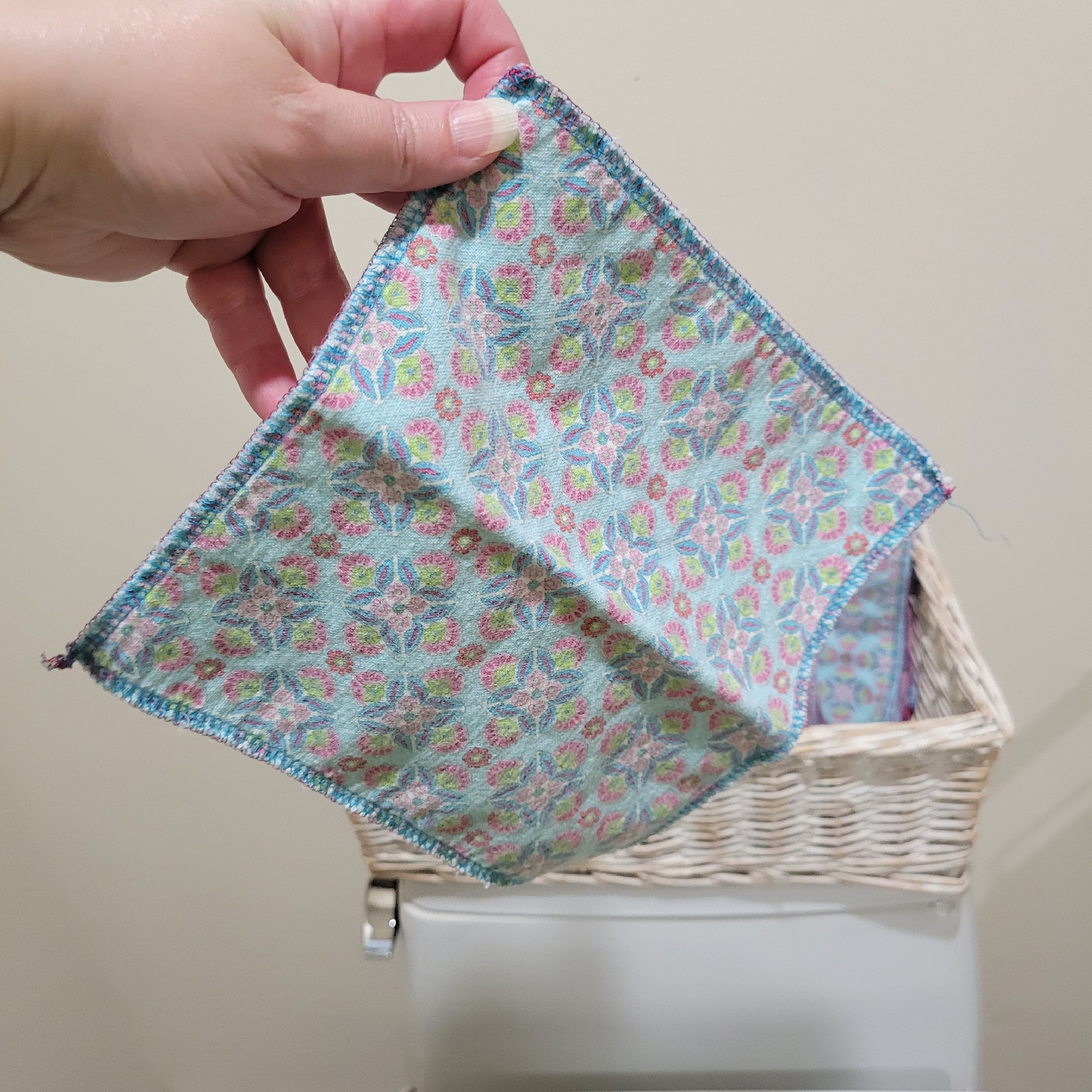
During the beginning of the pandemic when toilet paper was scarce, I made reusable wipes. I continue to use these 3 years later. I only use these for after urinating.  It really does cut down on how much toilet paper I use 

These can be made with scrap flannel. I serged the edges. These are double ply, but single ply would work just as well. Mine are cut close to an 8" square. They are not all exactly the same size as I was using scraps. 


Soon after I began using the washable wipes, I decided to make reusable tissues. With a household of allergy sufferers,  we could go through a lot of kleenex.  As we finished off the boxes of kleenex we had on hand, I saved the boxes and decoupage them to make them sturdy. I then found a dark flannel and cut my reusable tissues to 9" by 8" so they would fit inside the box folded in half.  They are serged around the edges and are single ply. 

My husband requested that he have some that were bigger and 2ply. He keeps his in a stack on his nightstand.  We have found these to be more absorbent and softer than traditional tissues. No more raw red noses when you have a cold with cloth tissues.

Everything is washed regularly on a sanitizing cycle in our washing machine and dried on high heat. Flannel lasts a long time and makes an excellent replacement for paper products.  

Earth Day Reusable Bags

We use reusable bags when we can. I try to keep a stash of them in my car for trips to the grocery store or other shops. But we do run out of them and I forget to restock the car.   Many of the bags we use are some that I have made. I love a big oversized bag that can  hold a lot of groceries. 


When I saw this fabric by B0rWear on Spoonflower,  I knew it needed to become a reusable bag. I swear, plastic  bags are the bane of my existence and I loathe them. Especially when I see them flying  in the wind like these are picture on the fabric. So I thought it made cute and ironic reusable bags. 


I don't have a specific pattern that I use for these. After I made a few following various patterns, I understood the construction process and started just doing them my own way and with my own measurements. I found that the patterns available online often make a bag that is the same size as your traditional plastic grocery bag, and I wanted mine bigger.   I have made all sizes and have a few extra large ones for using for Sam's Club purchases. 


Reusable bags are easy to make. Below are a few resources for free patterns to inspire you.


Making reusable bags is great for using up fabric that you may not love anymore or maybe it has flaws or stains. No one really cares what your reusable grocery bags  look like. Using a cloth bag is so much sturdier and you won't have to worry about the plastic bag ripping and tearing as you carry your groceries. Most importantly, you won't be using a plastic bag!

I hope you are enjoying all the blogs on  ecofriendly sewing.  There are many more planned. If you have any feedback or questions, please leave me a comment. Thanks!


Eco-Quilting: Sew Sustainable

Welcome Jody to my Blog Today! 

My name is Jody Groenendyk. I am a quilt pattern designer based out of Edmonton, Alberta, Canada. I am a scientist by day but a creative quilter at night! Creativity is a part of my everyday life. I enjoy designing and completing experiments in my daily work as a Biochemist, where I develop a ‘protocol’, very similar to designing a pattern. I experiment with fabric, quilt patterns, and quilting pantographs. I like modern, edgy, and creative designs. I own Gingerberry Quilts, a small, eclectic (AKA colourful), online quilt shop where I design quilt patterns, offer longarm quilting, and produce quilts, tea towels, bags, wall hangings and small quilted items. I am passionate about sustainability and transpar­ency in quilting but also about colour and living outside my comfort zone! Gingerberry is a nod to my traditional side, but I am drawn to anything Mid-Century Modern! I love pops of colour, all brought together with a neutral. I specialize in creating beginner and intermediate Mid Century Modern inspired quilt patterns. 

Eco-Quilting: Sew Sustainable.
What is this and why do I need to worry about it?

I had never heard of eco-quilting before reading a blog from a local fabric store. It got me thinking and I started to do research on discarded fabric (because I am a scientist...) and was horrified to discover that fabric accumulation in landfills is quickly becoming a global problem. In some countries, fabric waste can make up to 9% of the total solid waste each year! You may have seen the photos of the mountains of discarded clothing and fabric that cannot be reused. Furthermore, the textile industry uses a huge amount of energy, water, and other valuable resources to produce material. For example, cotton, although 100% natural and harvested from a quickly growing plant, is usually sprayed with pesticides and fertilizers, chemicals that normally would not go into the soil or groundwater. Fabric made using polyester and nylon uses byproducts produced from petroleum (oil), an industry which is a big emitter of greenhouse gases. Eco-Quilting can be one way to address fabric sustainability. Eco-quilting, similar to the three R's of waste recycling - Reduce, Reuse, Recycle, is the practice of repurposing, reusing, and recycling fabric. This involves introducing small habits into your everyday quilting routine that are friendly to the environment!

Some easy ones to include are:

Repurpose fabric from items around the home into new projects - such as unused sheets, shirts, and jeans and incorporate them into your quilts. I currently use handwoven cotton fabric from a baby wrap that I got at a thrift store into small makeup bags. Plaid shirts also make fantastic blocks!

Reuse second hand fabric from thrift stores. Every thrift store I have been in has a section for fabric. These are usually pieces of fabric that have come in as a donation that are essentially new. You can find some hidden gems in this section! These fabrics are also useful for a backing or accent fabric. 

Buy recycled fabric for projects. Recycled cotton is available and can be used for many different purposes. I use recycled cotton muslin for the backing of my pillow tops and wall hangings. No one sees this layer and it makes me feel better about my fabric choices! 

Another way to reduce fabric production is to use little to no-waste quilt patterns. This one is a little bit harder to monitor as these patterns are not usually marked as low waste. I recently made a quilt pattern that was featured in a popular quilting magazine and I was shocked at how much waste it generated. It was pieced in such a manner that I ended up cutting off the corners after another piece was added on top (similar to how flying geese are made with squares rather than triangles). Some of the pieces were 11" though and generated huge chunks of fabric. Fortunately, I can use this fabric in other projects, but I would prefer to use a pattern that starts out with little to no waste. To try to counteract these types of patterns, I design little to no waste quilt patterns, such as the Lynn County Quilt Pattern and the Free Rockies Quilt Pattern. 

Use the fabric in your stash for the next new project. Try to challenge yourself to make a quilt using fabric that you don't like anymore or won't use in other projects. You could use this fabric to make quilts to donate to those in need, such as for Blankets of Love, a charity that gives a quilt to people that are currently in mental health facilities across Canada. www.blanketsoflove.ca

Finally, use up those scraps! Little pieces can be used for puff quilts, seaglass wall hangings, pet beds, scrappy bags or anything that uses small pieces. Keep all your bits of batting and backing and use them to fill pillows or foot stools! 


The other option is to give your scraps to someone else. There are many people who are unable to afford large amounts of fabric and love using scraps. Ask around in your guild or even in quilting Facebook groups. Lots of quilters will be interested!

Hopefully incorporating these small changes will affect the amount of fabric that goes to landfill!

To learn more tips and tricks, check out my newsletter, Bad Choice Stories, at www.gingerberry quilts.ca. When you sign up, you will get a Free Rockies Quilt Pattern, a Free printable Ah-Mazing Monthly Quilt Planner and a great selection of Bad Choice Stories!

To celebrate Earth Month, I am giving 10% off of all my products on my website for the month of April. Use the CODE: BLOGHOP! Check it out at www.gingerberryquilt.ca.


Disclosure: This post may contain affiliate links. These links provide me with a small compensation if you make a purchase using my link. There is not cost to you when you do this. My thoughts and opinions given in this blog post are mine.

Earth Day inspired art quilt using upcycled materials and craft items

The following post is by TJ Wright...


Inspire, create, and celebrate earth day with a sustainable designed art quilt by utilizing recycled materials and items found in nature!

How and why, I was inspired to design a tutorial for quilters to create an earth day art quilt using upcycled materials.

While we celebrate sustainable quilt-making techniques, it's essential to acknowledge our environmental impact and find ways to reduce it. Sustainable quilt-making techniques provide an excellent opportunity to create beautiful and functional pieces while minimizing the impact on the planet. These techniques include using sustainable materials such as organic cotton or linen, upcycling old clothing, and reducing waste during the quilting process. By using sustainable quilt-making techniques, we can help reduce the amount of textile waste sent to landfills and minimize the carbon footprint of our craft. So, let's celebrate by engaging in sustainable quilt-making practices and demonstrating our commitment to a healthier planet.

If you are a quilter for any length of time you undoubtedly have scraps of fabric and bits of batting hanging around? This quilt project is a great way to repurpose, reuse and upcycle. I was asked by an art quilt collector to create a piece using cloth they had collected from India and items they had found on adventures with their family. What a better way of honoring mother earth and raising awareness to repurpose your treasures.


Design and craft an earth day inspired art quilt. This is a great opportunity to upcycle, reuse, and recycle scrap fabric.

Get started with your inspirational quilting journey by repurposed batting and (3)- 12' X 12" pieces of backing fabric from your stash for the foundation. No need to patchwork piece the top, cut the fabrics into ragged strips and layered them over each other to create the top, covering all of the batting, you will have a raw edge effect. One of my favorite techniques is to combine and introduce different shades tulle and mesh for more texture over the top of the fabrics, get creative by adding multiple layers of tulle and mesh. Using fork pins, or pins you have on hand, pin all the layers of your quilt in place.


Thread your sewing machine with decorative contrasting thread to quilt all the layers together, I use a walking foot to create a straight-line, matchstick pattern or free-motion foot to create a meandering organic quilting. Get creative, this is a perfect time to practice with your thread choices and quilting techniques, you will applique found objects and small pieces so you can easily conceal quilting mishaps. At this point trim your quilt to 10" x 10" for the finished size. Use a zig zag or decorative edge stitch to finish all the edges of your pieces.


Applique and collage upcycled treasure and trash together to create a genius earth day crafted quilt.

Create something new with leftover old items and materials that would be forgotten. Making something a lovely masterpiece is easy to diy, practice artistic hand stitching using embroidery thread, yarns and twine. Using hands-on visible mended method is a spectacular way to embellish and applique found items to your quilt. 

The ocean theme art quilt that is photographed here is a wonderful tribute to the memories for my client to hang and enjoy in their home for years to come. You can see how you can make this project your own to share with family and friends. It all starts with your own creativity.

About: In the beginning I started quilting to continue to learn new sewing skills and challenge myself. I was taken with all the beautiful fabrics and the creativity around quilting and felt it was the perfect match for me. I started by taking a quilting class at a local quilt shop where I learned the basics. Then I continued to build my skills on my own. I enjoy making quilts for conventional reasons, but I really love art quilting and expressing my quilting voice. My hope is to inspire others to do the same, so follow along and quilt with me. You can find me at www.tjwrightquilts.com or follow me @tjwrightquilts on Instagram, Facebook, and Pinterest.


Earth Day Blog Hop

Happy April 1st! Some call April Earth Month. Earth Day is on April 22 and this year I am hosting a Blog Hop. 

The Blog Hop will officially start tomorrow, but I wanted to post a little about it now. 


The Blog Hop will occur in two places - here on my blog and on Instagram. The creators in the graphic above will be participating and the first blog post will be posted tomorrow here on my blog. TJ Wright will be a guest blogger. 

I will be sharing different posts on Instagram daily and will be doing a few different giveaways. Terrance Williams of Terrance Williams Designs made some headbands using fabric from Spoonflower that I will be giving away. 


  I hope you check back in regularly to see what eco-friendly projects and ideas we have to share as we celebrate Earth Day. 


Follow me on Instagram and Facebook!

Disclosure: This post may contain affiliate links. These links provide me with a small compensation if you make a purchase using my link. There is not cost to you when you do this. My thoughts and opinions given in this blog post are mine.